Volleyball overlap rule: what is a rotation fault
Updated October 5, 2026
An overlap — also called a rotation fault, or a positional fault in the FIVB rulebook — means players are out of their rotational order at the moment of the serve. It gets called more often than people expect, especially in the 5-1 system, where players shift toward their real positions before the serve. This page covers what the rule actually requires, who is compared with whom, and how to avoid giving away a free point.
What is an overlap in volleyball
Under FIVB rule 7.4, at the moment the server hits the ball the players of the receiving team must stand in their rotational order. Since the FIVB Official Volleyball Rules 2025–2028 this applies to the receiving team only: the serving team may stand wherever it likes.
If any receiving player is out of position relative to their neighbours at the service contact, the team commits a positional fault (7.5.1). Only that instant counts: before the hit players can move as much as they want, and after it they can go anywhere (7.4.4).
The second referee watches the receiving team's positions (24.3.2.2). The penalty is the loss of the rally (7.5.4): the serving team scores, keeps the serve, and the receiving players are put back in the correct order.
Who overlaps with whom
Each player is compared only with their neighbours, not with everyone on the court. There are seven pairs in total.
Front and back in the same column — 4–5, 3–6, 2–1. The front-row player must be closer to the net than the back-row player behind them.
Neighbours in a row — 4–3 and 3–2 at the net, 5–6 and 6–1 in the back. The left player must be further left and the right player further right (as you face the net from your own side). Strictly, rule 7.4.3.2 compares each side player with all the other players in that row, but in practice, if the neighbours are in order, that is enough: whoever is left of zone 3 is almost always left of zone 2 too.
Diagonal players are not compared. The zone 1 player may stand closer to the net than the zone 3 player, as long as they stay behind the zone 2 player and to the right of the zone 6 player. So the middle zones (3 and 6) have three neighbours each, and every other zone has two.
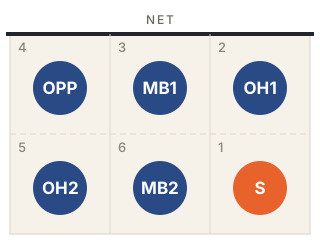
Here is rotation 1 from the diagram:
- Setter (zone 1) must be behind outside 1 (zone 2) and to the right of middle 2 (zone 6). That is why, on serve receive, the setter hides behind outside 1 near the right sideline: close to the target and still legal.
- Opposite (zone 4) must be left of middle 1 (zone 3) and closer to the net than outside 2 (zone 5). They cannot slide over to the right side before the serve — they would pass the middle. That move waits for the server's contact.
- Middle 1 (zone 3) sits between the opposite and outside 1 and must be closer to the net than the zone 6 player.
How the referee judges it: the feet
A player's position is determined only by the feet (7.4.3). A raised foot counts where it last touched the floor. The body and arms don't count: you can lean forward as long as your feet are in the right place.
The 2025–2028 FIVB rules word it from the back player's side: each back-row player must be level with or have at least part of one foot further from the centre line than the front foot of the corresponding front-row player (7.4.3.1). Side-by-side pairs are judged the same way by distance to the sideline: a side player must be level with or have at least part of one foot closer to their sideline than the other players in that row (7.4.3.2).
So feet exactly level are not a fault, and the trainer treats them as legal too. On court, though, the safe habit is to leave your neighbour a clear margin — "level" by eye easily becomes "ahead".
The server and the libero
The serving team. Since 2025 only the receiving team has to keep its order at the serve, so the serving team cannot commit an overlap: its players may start in their playing positions. The right player still has to serve — the one who rotated into zone 1. Serving out of turn is a separate fault (7.7) and has nothing to do with where players stand.
The receiving team is bound by everything above: all six players on court, including the libero if they are in.
The libero takes the place of a back-row player — in a 5-1 usually a middle — and is bound by the same order as the player they replaced. If the libero is in zone 5, at the serve they must be behind the zone 4 player and left of the zone 6 player.
Under FIVB rules the libero may not serve (19.3.1.3): when the middle they replace reaches zone 1, the middle serves. In recreational games the libero often serves anyway — that is common practice, not a rule. The trainer's default "Amateur" rule set models that practice; "Official" follows FIVB.
How to avoid an overlap on serve receive
- Move only after the contact. Your cue is the server hitting the ball — not the whistle and not the toss. The classic mistake is starting your run a split second early.
- Know your neighbours in every rotation. There are two or three of them, and they are the only ones you must stay in order with. Everyone else you can pass freely.
- Hide players legally. A back-row setter can stand right behind their front-row neighbour, and the opposite can tuck in next to the middle. Just don't pass a neighbour, not even with one foot.
- Leave a margin. The tighter a pair stands, the easier it is for a last-second shuffle to turn into a fault.
For how players line up in all six rotations and where they go after the serve, see volleyball rotations.
Work through the rule step by step in the lessons: zones, rotational neighbours, feet and the libero, with an explanation after every answer.
Read next
- Volleyball rotations: the six 5-1 rotations zone by zoneHow players rotate clockwise through the zones, all six rotations of the 5-1 and where the setter goes in each.
- Volleyball 5-1 rotation explained: positions and rolesWhat the 5-1 system is: one setter, an opposite, two outside hitters and two middles — where each stands and why teams play it.