Volleyball 5-1 rotation explained: positions and roles
Updated October 5, 2026
The 5-1 is the most common system in volleyball, from recreational leagues to national teams: one setter runs the offense and the other five players attack. This page explains the roles, how the players line up on the court, and what the system gains and costs.
What "5-1" means
The numbers stand for five hitters and one setter. The same setter takes the second contact in all six rotations — whether they start at the net or in the back row. In a 4-2 there are two setters standing opposite each other, and whoever is in the front row sets, so only two hitters are ever at the net. A 6-2 also has two setters, but the back-row one sets and the front-row one hits, so there are always three attackers at the net — at the price of needing two equally good setters. The 5-1 sits in between: one setter for the whole match and, most of the time, three hitters in front.
The six positions
- Setter (S) — takes the second ball on almost every attack and decides who hits.
- Opposite (OPP) — the team's main scorer. Usually stays out of serve receive, attacks from the right side at the net and from zone 1 in the back row.
- Outside hitters (OH1, OH2) — attack from the left, pass the serve and dig.
- Middle blockers (MB1, MB2) — the main blockers, hitting quick sets through the middle.
The serving order around the circle is S → OH1 → MB1 → OPP → OH2 → MB2. Each pair sits three places apart, which puts them on opposite corners of the court: the setter is opposite the opposite (hence the name), OH1 opposite OH2, MB1 opposite MB2. That gives the 5-1 its key property: in every rotation one player of each pair is in the front row and the other is in the back row. The net always has exactly one outside and one middle, and the third front-row player is either the setter or the opposite.
There is also a seventh role, the libero (L): a back-row specialist who usually comes in for a middle blocker once that middle rotates to the back row. How the libero fits into the rotational order, and why FIVB rules don't let them serve, is covered in the overlap rule article.
5-1 rotation diagram
The court is split into six zones. At the net, left to right, are zones 4, 3 and 2; in the back row, zones 5, 6 and 1. The player in zone 1 serves. In the trainer, the rotation number is the setter's zone, so in rotation 1 the setter is in zone 1 (the same idea as the "P1–P6" labels many coaches use).
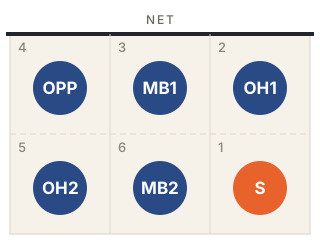
Reading the diagram:
- Three hitters are in the front row: the opposite (zone 4), middle 1 (zone 3) and outside 1 (zone 2).
- The setter is in zone 1, right back. On their own team's serve they serve; on the opponent's serve they run to the net between zones 2 and 3 as soon as the server hits the ball.
- Middle 2 in zone 6 is the player the libero most often replaces.
Keep in mind that a rotation diagram shows order, not exact spots. The rules only require the receiving team to keep that order at the moment the server contacts the ball. Before the serve, players shift as close to their real positions as the order allows; right after the hit they switch: in rotation 1 the opposite runs from zone 4 to the right side and outside 1 from zone 2 to the left. The rotations article walks through this switch in detail.
Pros and cons of the 5-1
Pros.
- One setter. Hitters get used to a single set — its height, tempo and habits — and the setter sees the whole match and runs the offense to one plan.
- Three front-row hitters in three rotations, when the setter is in the back row (zones 1, 6 and 5). With attacks possible from the left, middle and right, the opponent struggles to put up a double block.
- The opposite can attack from the back row, so even the weaker rotations keep an extra option.
Cons.
- In the other three rotations (setter in zones 4, 3 and 2) only two hitters are at the net. The setter can dump the second ball, but that is a surprise play, not a main attack.
- The setter has to reach the target from every zone. The longest runs are from zone 5 in the back row and from zone 4 at the net, where they cross the whole court to the right.
- The more players switch after the serve, the harder it is to build a legal serve-receive formation. A mistake there costs a point.
- Every set depends on one player: if the setter has a bad day, the system has no built-in backup — only a substitution.
Where to practise
- All six rotations zone by zone, and how the team moves from one to the next: Volleyball rotations.
- Who must stay in order with whom at the serve, and how to avoid an overlap on serve receive: Volleyball overlap rule.
- A full rally — serve, pass, set, attack and defence in any rotation — in Tactics mode.
Read next
- Volleyball rotations: the six 5-1 rotations zone by zoneHow players rotate clockwise through the zones, all six rotations of the 5-1 and where the setter goes in each.
- Volleyball overlap rule: what is a rotation faultWhen the referee calls a rotation (overlap) fault: which players must stay in order before the serve, how feet are judged and what it costs.